Prayer in the Dry Places: What Am I Feeling Today?


Becoming curious about the emotional landscape within
Sometimes in prayer, God feels close. Prayer seems to move. Scripture touches us. We sense connection, trust, peace, or even intimacy. We may not understand exactly what God is doing, but we feel a sense of relationship. Then there are other times. We sit down to pray and...nothing. I don’t feel anything; God feels distant - prayer feels dry.
I understand what we mean when we say these things. But lately, I have become curious about that word: nothing. Because are we really feeling nothing? I mean, I could describe my coming into these places as:
I am bored.
I am disappointed that prayer doesn’t feel the way it did yesterday.
I am tired.
I am irritated.
I am lonely.
I am longing for something I cannot quite name.
“Nothing” is not the end of the conversation. Rather, could it be where prayer in the dry places begins?
Prayer in the Dry Places Begins with Curiosity
Over these past several weeks, we have been exploring our interior movements. We began by noticing patterns of grace, those familiar ways God seems to touch us and draw us closer. Then we began noticing what gets in the way, the movements that can constrict our freedom. Finally, we explored practical tools that can help create room again.
Now I want to move a little closer to: What is actually happening within me while all of this is occurring?
Our interior landscape is wonderfully complicated. Feelings, emotions, desires, aversions, memories, bodily sensations, wounds, grace. They mingle and move within us all day. A smell can awaken a memory; someone’s tone of voice can touch something tender; a conversation can leave us carrying something we weren’t carrying before it began. The landscape of our Garden Within can shift within us in seconds.
None of that is automatically good or bad! It is information, and information gives us something to become curious about with God.
Using an Emotions Wheel in Prayer in the Dry Places
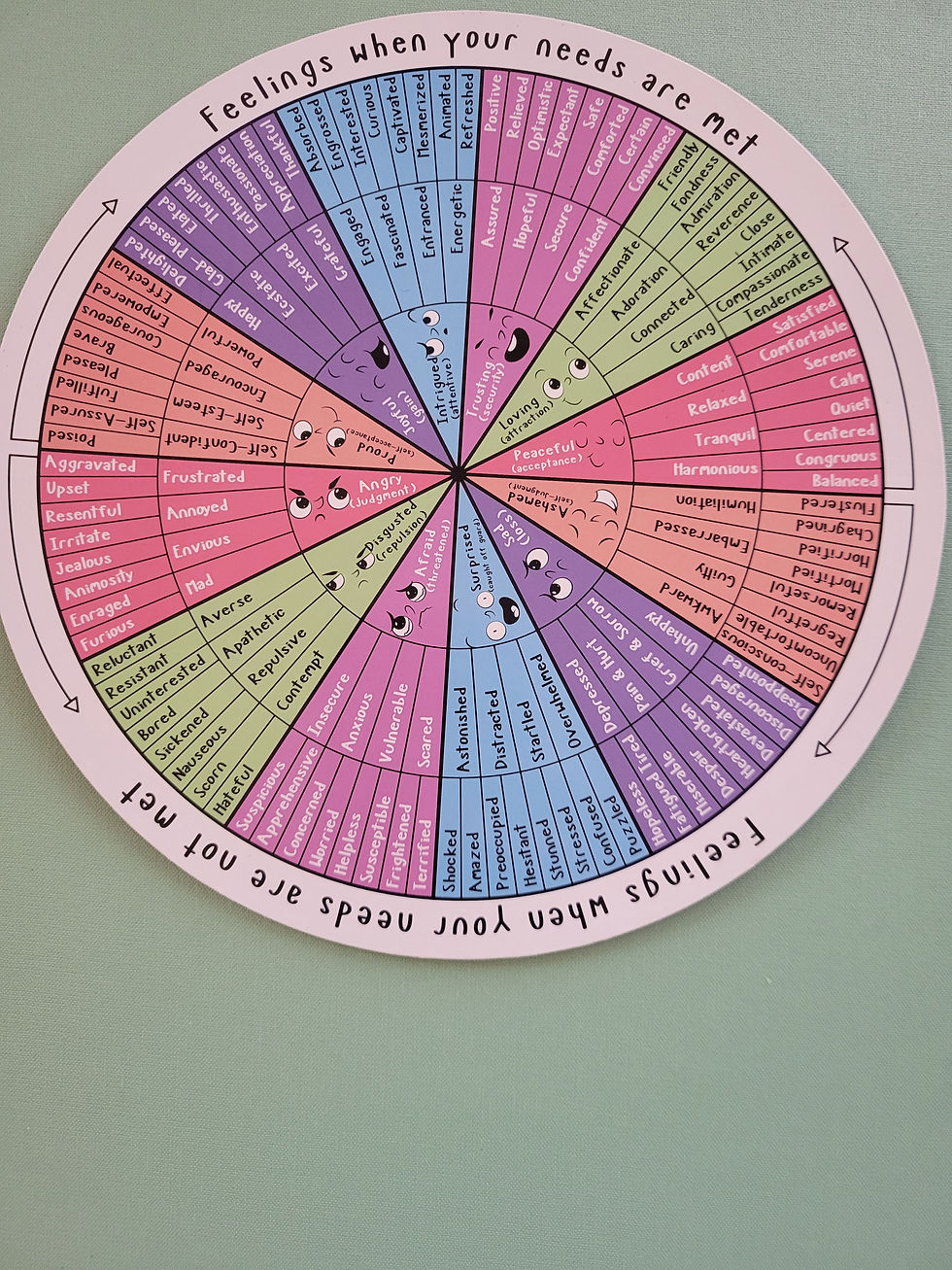
This week, I am attaching an emotions wheel to this reflection. I encourage you to print it, save it, or simply pull it up during prayer. Then begin with one very simple question: What am I feeling today?
Don't worry about getting the answer “right.” It is your Garden Within, and only you know the answer here; that answer is always valid.
Choose a word that seems close. Then use the wheel to become more specific. Let me give you an example. Suppose I sit down for morning prayer and notice: I’m angry.
Okay. Rather than immediately asking whether I should be angry, I can become curious. In this instance, it doesn’t really matter whether I should be, because, well, I am. And that is where we begin, knowing God meets us there.
Looking at the wheel, perhaps I recognize that my anger feels more like frustration. I stay with it. Is the frustration closer to being upset? Or am I aggravated? Today, perhaps the word is: Aggravated.
Now we’re getting somewhere. I haven’t solved anything or judged whether my aggravation is justified. I haven’t tried to make it disappear; I simply know a little more about what is present within my Garden today. And now I have something real to bring to God.
Prayer in the Dry Places Doesn’t Require Me to Fix What I Feel
This is where I want us to be careful. The emotions wheel I am sharing has feelings tied to needs being met and feelings tied to needs not being met. That does not mean one side is good and the other is bad. If I am aggravated, I may have a very good reason: something may need my attention, someone may have crossed a boundary, a conversation may need to happen, or perhaps something has poked an old wound within me that needs care.
I don’t use the emotions wheel to get myself from the “wrong” side to the “right” side. Instead, I become curious about the needs within me, and invite God into them. How? On this particular wheel, if I look all the way across from aggravated, I find satisfied. Now I have another possibility to bring into prayer:
God, I am aggravated. I can feel this working within me. I wonder what satisfaction might look like here. Will You walk with me in this?
Satisfaction doesn’t give me the answer. It is not as if, "Oh, I should be satisfied, so therefore I will be"-no! Perhaps God and I will discover that I need to have a conversation, that being the root of my aggravation. I could fear needing to act this way, and leaning into God’s strength and compassion to enter this dialogue creates a sense of satisfaction.
It could also prompt a deeper exploration that invites me to wait - perhaps God desires to lend me a new perspective or open my eyes to the other’s view of the situation. Is it the waiting itself that aggravates me, and could I find satisfaction in waiting beside God?
Still, the invitation could lead me toward healing some wounded pattern of behavior, say avoidance of conflict, within myself that I don’t necessarily know yet. Prayer is happening in a deep relational way in all three scenarios. Far from “nothing.”
The grace we pray for doesn’t determine the action. It opens the discernment.
Prayer in the Dry Places Includes the Body
This practice has another layer. Once I find a word, I can ask: Where do I experience this within my body?
Is there tightness in my chest?
A heaviness in my stomach?
Heat in my face?
Do my shoulders rise?
Does my breathing change?
Do I want to move toward something?
Do I want to pull away?
Again, we don’t have to decide what any of this means immediately. We are learning ourselves, and the God that walks in that Garden with us. This becomes particularly important because our bodies can sometimes recognize a movement before our minds have found language for it. Adam and Eve hid, reacting to the desire to pull away. This happened before a conversation ever ensued.
The more familiar I become with my own interior landscape, the more readily I may recognize: Something just changed. And instead of immediately reacting, I can become curious.
Prayer in the Dry Places Also Notices Grace
We can practice this same curiosity when we are experiencing something beautiful. Suppose I enter prayer and recognize: I feel loving.
I stay curious. Loving becomes connected. As I continue outward on the wheel, perhaps the word that catches my attention is intimate. I feel intimate with God. How beautiful! I desire deeply to receive it.
I don’t need to become suspicious of it simply because I know the spiritual life changes. But I can learn from it. Intimacy is a tender place in my own story. I know that intimacy can also awaken woundedness within me. Sometimes, as another person moves closer, I can experience nausea in my body.
Knowing this about myself doesn’t ruin the intimacy. It actually gives me greater freedom within it. If I am experiencing beautiful intimacy with God and that openness begins flowing into greater intimacy with my husband, I can receive it. If nausea suddenly rises within me, perhaps I can recognize: There it is. I don’t immediately have to conclude that something is wrong. I can name it and even bring it into the light with my husband: I’m noticing that old wound moving within me.
Awareness gives me room to remain in relationship rather than simply reacting to what my body is experiencing.
Prayer in the Dry Places: What Am I Bringing Into the Room?
This practice also reaches far beyond what happens during our private prayer. We bring our interior landscape everywhere we go:
Into our marriages.
Our friendships.
Our families.
Our communities.
Our workplaces.
Our churches.
Sometimes I enter a conversation carrying something before the other person has said a word. Other times, I notice something arise within me during the conversation. If I don’t know myself very well, those movements can become tangled together remarkably quickly. Someone else’s anxiety can stir my anxiety; their anger can touch my woundedness, even another's sadness can awaken my grief.
That doesn’t mean I should become detached from the people I love. Quite the opposite.
Self-awareness can help me remain present to another person without immediately becoming consumed by what is moving within me.
It helps me notice:
Wait. Something shifted.
What am I carrying right now?
Was this present when I entered the conversation?
What has been awakened within me?
I may not know the answer, and that’s okay. Curiosity itself creates room.
A Daily Practice for Prayer in the Dry Places
For this week, I want to invite you to keep this very simple. Bring the emotions wheel into your daily prayer. Take a breath. Notice your body. And ask: What am I feeling today?
Find a word. Then become more specific. What happens in your body as you name it?
You may want to look across the wheel and notice the corresponding word there, not as something you should be feeling, but perhaps as a grace you might bring into conversation with God, asking: God, what are You and I walking with today?
For this week, that’s enough. You don’t have to analyze yourself or fix yourself. You most definitely don’t have to turn anger into peace, sadness into joy, anxiety into trust, or dryness into consolation. This is a gift of noticing your Garden Within at another layer.
Become curious. Adam and Eve were curious. Unfortunately, they forgot to invite God into that curiosity. We are going to invite God into that very place. Because perhaps when I say, “God feels distant,” the first invitation isn’t to figure out how to make God feel close again.
Perhaps the invitation is simply to ask: What does distant feel like in me today? And then allow God to meet me there.
An Embodied Pause for Prayer in the Dry Places
Place your feet on the ground and allow yourself one slow breath. Notice your body before searching for words:
Where is there tightness?
Where is there ease?
Where do you feel drawn inward?
Where do you sense openness?
Now look at the emotions wheel. Allow one word to catch your attention. Follow it outward if another, more specific word fits. Then place your hand on the part of your body where you feel it most clearly.
And enter this place of In-Body prayer: God, this is what I bring to You today. Will You walk with me here?
Remain there for a few breaths.
Journaling Through Prayer in the Dry Places
What am I feeling today, and what happens when I become more specific about that feeling?
Where do I experience this movement within my body, and what does it make me want to move toward or away from?
If I look across the emotions wheel, what grace catches my attention? What might it mean to ask God for that grace without trying to erase what I am actually feeling?
A Closing Prayer
God who knows my Garden Within, meet me in what is actually here. Teach me to notice without judging, to listen without rushing, and to become curious about the life moving within me. Walk with me in all that I bring today. Amen.
From the garden within me to the garden within you, where God awaits,
Kimi


Comments